Christian symbols and their meaning share one common thread: every sign points to Jesus Christ or to a central message of the Bible. The cross stands for death and resurrection, the fish (Ichthys) is an early confession of faith, Alpha and Omega mean beginning and end, and the dove represents the Holy Spirit. Many of these signs date back to the first centuries of Christianity.
You come across them on gravestones, in church windows, on clothing and in logos, often without being able to place them. Here we present twelve of the most important signs briefly and factually, each with the Bible passage it goes back to. At Good-Natured, some of them also appear on our socks, knitwear and posters; more on that at the end.
• Core signs: cross, Ichthys, Alpha and Omega, Chi-Rho.
• Picture signs: dove, anchor, lamb, Good Shepherd, vine.
• Shapes and light: triangle, candle, rainbow.
• Origin: almost all of the signs go back to specific Bible passages.
• Older than the cross: the fish, the anchor and the shepherd appear in early Christian art before depictions of the cross.
1. Christian symbols and their meaning: the four core signs
Four signs form the core. They point directly to Jesus Christ, which is why they are still the most widespread today, on altars as well as on jewellery or on pieces from our Christian Gifts collection.
Cross. The central sign of Christianity. Originally the cross was a Roman instrument of execution; it only became established as a visual symbol in the 4th and 5th centuries, after Emperor Constantine had abolished crucifixion as a punishment. Paul calls the preaching of the cross “the power of God” (1 Corinthians 1:18). Besides the Latin cross there is the equal-armed Greek cross and the T-shaped Tau cross. More on its history and the different forms in our article on the meaning of the cross as a symbol.
Ichthys, the fish. The Greek word for fish, ΙΧΘΥΣ, forms an acrostic for “Jesus Christ, Son of God, Saviour”. The fish is one of the oldest Christian signs of recognition and is attested in inscriptions and catacombs from the 2nd and 3rd centuries. How the Ichthys fish and its meaning fit together is explained in a separate article.
Alpha and Omega. The first and last letters of the Greek alphabet. In Revelation, Christ says: “I am Alpha and Omega, the beginning and the end, the first and the last.” (Revelation 22:13). The sign stands for a God who embraces beginning and end. More detail: Alpha and Omega: meaning.
Chi-Rho. The superimposed Greek letters Χ (Chi) and Ρ (Rho), the first two letters of “Christos”. Emperor Constantine had the monogram placed on military standards in the 4th century, after which it spread quickly. It is often framed by Alpha and Omega.
2. Picture signs from the Bible
Dove. It stands for the Holy Spirit. At the baptism of Jesus, he saw “the Spirit of God descending like a dove” (Matthew 3:16). With an olive leaf in its beak, it refers to the story of Noah (Genesis 8:11) and means peace.
Anchor. A sign of hope. The Letter to the Hebrews describes hope “as an anchor of the soul, both sure and stedfast” (Hebrews 6:19). The anchor is found frequently in the Roman catacombs, sometimes with a crossbar that recalls a cross.
Lamb. John the Baptist says of Jesus: “Behold the Lamb of God, which taketh away the sin of the world.” (John 1:29). The image takes up the Passover lamb from Exodus 12. Shown with a victory banner, the lamb stands for the resurrection and belongs to Easter.
Good Shepherd. “I am the good shepherd”, says Jesus in John 10:11. The shepherd carrying a sheep on his shoulders is one of the oldest Christian images and was painted in the catacombs long before the cross was depicted. Its roots go back to Psalm 23, which we explain verse by verse in Psalm 23: meaning. Our Lost Again Poster takes up the motif with humour: a black sheep that the Good Shepherd goes after again and again (ab 18 €).
Vine and branches. “I am the vine, ye are the branches” (John 15:5). The image describes the connection between Christ and believers and says that fruit does not grow by our own strength. Which fruit is meant is shown in Galatians 5:22; more on this in Fruit of the Spirit.


3. Shapes, light and colours
Triangle and shamrock. Images of the Trinity of Father, Son and Holy Spirit: three parts, one shape. The triangle is often found in church windows and vaults, frequently with an eye in the centre. According to legend, the shamrock is associated with Saint Patrick.
Candle and light. Jesus says of himself: “I am the light of the world” (John 8:12). At the Easter Vigil, the Easter candle is lit from the fire and carried into the dark church. In Advent, the candles on the wreath count the weeks until Christmas; why there are four is explained in Advent: the meaning of the candles. The call to be a light yourself is the subject of Matthew 5:16.
Rainbow. After the flood, God says: “I do set my bow in the cloud, and it shall be for a token of a covenant between me and the earth.” (Genesis 9:13). Today it is also used in other contexts, which is worth knowing if you use it as a motif.
• Chi-Rho: often mistaken for a crossed-out P.
• Omega (Ω): confused with the ohm sign or a horseshoe.
• Tau cross: mistaken for an incomplete Latin cross.
4. Christian symbols in everyday life
Precisely because they are simple, Christian symbols work well on small surfaces. At Good-Natured we use this in several pieces. The Cross Socks have an embroidered cross, are made with 80% cotton (GOTS) and knitted in Saxony, Germany (12 €). The Alpha & Omega Socks have the motif knitted in (12 €).
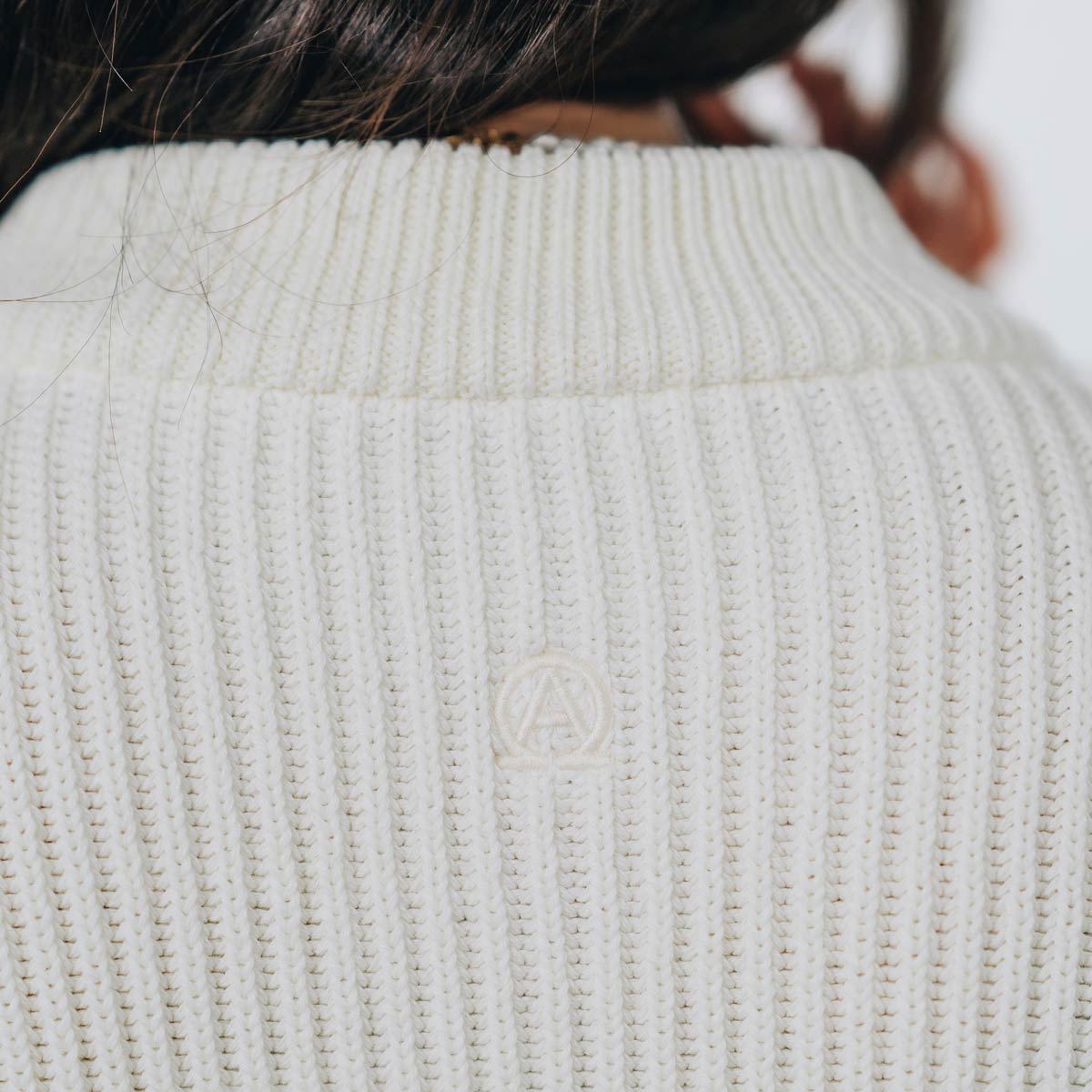
For cold days there is the Alpha & Omega knit sweater with embroidered lettering on the front and the symbol on the back, made in Portugal: as the Knitwear Sweater Women (63 €) and the Knitwear Sweater Men (68 €). For your wall there is the Alpha & Omega Poster (ab 10 €) or the Let Your Light Shine Poster on the theme of light (ab 18 €), both printed in Germany on FSC-certified paper.
Conclusion
Most Christian symbols came about for a practical reason: they had to be quick to draw and easy to recognise. Almost every one goes back to a specific Bible passage, and anyone who knows that passage sees more in the sign than decoration. That is exactly why these signs still work today where space is limited: on a sock, a sweater, a poster. You will find a selection of such pieces from Good-Natured in our Christian Gifts collection.
Frequently asked questions
What is the oldest Christian symbol?
Among the oldest are the fish (Ichthys), the anchor and the image of the Good Shepherd. They are attested in inscriptions and wall paintings in the Roman catacombs from the 2nd and 3rd centuries. The cross, by contrast, was depicted more often only from the 4th century onwards.
What does the PX sign in churches mean?
The apparent “PX” is the Chi-Rho, a monogram of Christ made of the Greek letters Chi (Χ) and Rho (Ρ). It represents the first two letters of “Christos”. You find it on altars, vestments and early Christian grave slabs, often framed by Alpha and Omega.
Which symbols stand for the Holy Spirit?
The best-known sign is the dove, along with fire and tongues of flame from the Pentecost account in Acts 2:3. Wind and breath are also images of the Spirit, because the Hebrew word “ruach” means both. In churches you often see the dove above the baptismal font or in the dome.
Are there modern Christian symbols too?
Yes, for example the letters WWJD on wristbands, which became popular in the 1990s. They go back to the question “What would Jesus do?”, which Charles Sheldon popularised in his 1896 novel “In His Steps”. More on the meaning of WWJD in a separate article.

Ten biblical names of God and what each of them says about an experience with God.
Read the article ↗